
Paul George, MD, Associate Professor in the Department of Neurology at Stanford University and Chair of the AAN Science Committee, discussed emerging research in autoimmune neurologic diseases, CAR T-cell therapy in stiff person syndrome, and potential CNS effects of GLP-1 therapies. Jacqueline French, MD, Professor of Neurology at NYU Langone Health, presented phase 3 findings on a novel therapy for treatment-resistant focal epilepsy.

-
Morad Daniel2moThis would be a very useful tool. -
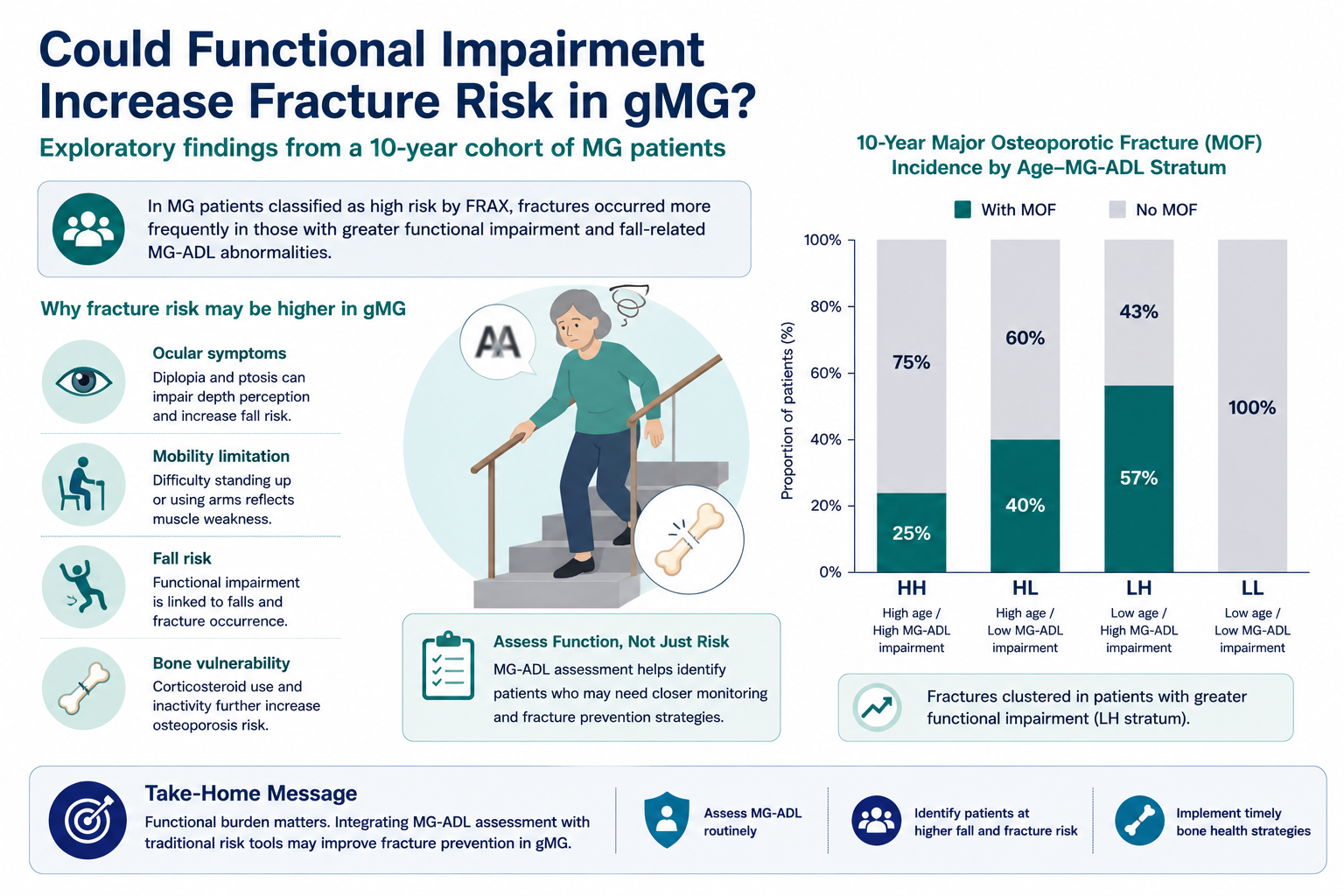
BRETT NILE2moyes it could and this is a great visual aid. Helpful for both providers and patient information. Fracture risk could help you convince patients to start treatment.
Show More Comments

Patient Background:
Ms. L is a 44-year-old female with a 3-year history of generalized myasthenia gravis (gMG) who is acetylcholine receptor (AChR) antibody-positive. Despite treatment with pyridostigmine 60 mg four times daily and azathioprine for 18 months, she continues to experience significant limb-girdle weakness, fatigable ptosis, and dysphagia, with two myasthenic crises requiring IVIG during the past year.
MG-QOL15r score is 21/45, indicating substantial disease burden. Comorbidities include hypertension and type 2 diabetes mellitus. BMI is 27 kg/m². She expresses concern regarding long-term corticosteroid exposure and wishes to avoid high-dose steroid therapy.
Assessment & Diagnosis:
AChR antibody titer is markedly elevated at 28 nmol/L. MG-ADL score is 11, consistent with significant functional impairment. Pulmonary function…read more
remains stable, with forced vital capacity greater than 80% predicted. CT imaging demonstrates no evidence of thymoma.
Diagnosis: refractory generalized acetylcholine receptor antibody-positive myasthenia gravis.
The care team initiates FcRn-targeted therapy as part of a steroid-sparing immunomodulatory treatment strategy.
- Please provide a minimum of a 3 sentence response.
- 1.How does FcRn antagonism mechanistically reduce pathogenic IgG levels in generalized myasthenia gravis?
- 2.How should MG-ADL scores be used to assess treatment response and ongoing disease control?
- 3.How would you counsel this patient regarding long-term immunosuppressive management alongside FcRn-targeted therapy?
-
SACHINKUMAR PANCHAL2moIn Myasthenia gravis, FcRn antagonism reduces pathogenic IgG levels by blocking the neonatal Fc receptor (FcRn), which is responsible for protecting IgG from lysosomal degradation. When FcRn is inhibited, IgG—including Show More -
Anonymous User2moFcRn antagonism works by blocking the neonatal Fc receptor that normally salvages IgG antibodies from lysosomal degradation and recycles them back into circulation. By occupying this receptor, FcRn-targeted therapy accelerates Show More
Show More Comments
Clinical effectiveness of efgartigimod in a broad population of patients with generalized myasthenia gravis: subgroup analyses from a randomized, double‑blind, placebo‑controlled, phase 3 trial (ADAPT). - PubMed
Source : https://pubmed.ncbi.nlm.nih.gov/42234197
Explore the ADAPT trial findings on efgartigimod's effectiveness and safety in AChR-Ab+ generalized myasthenia gravis across various patient subgroups.
Efgartigimod showed efficacy and was well tolerated in AChR-Ab+ generalized myasthenia gravis across diverse subgroups. TEAEs were similar to placebo.