




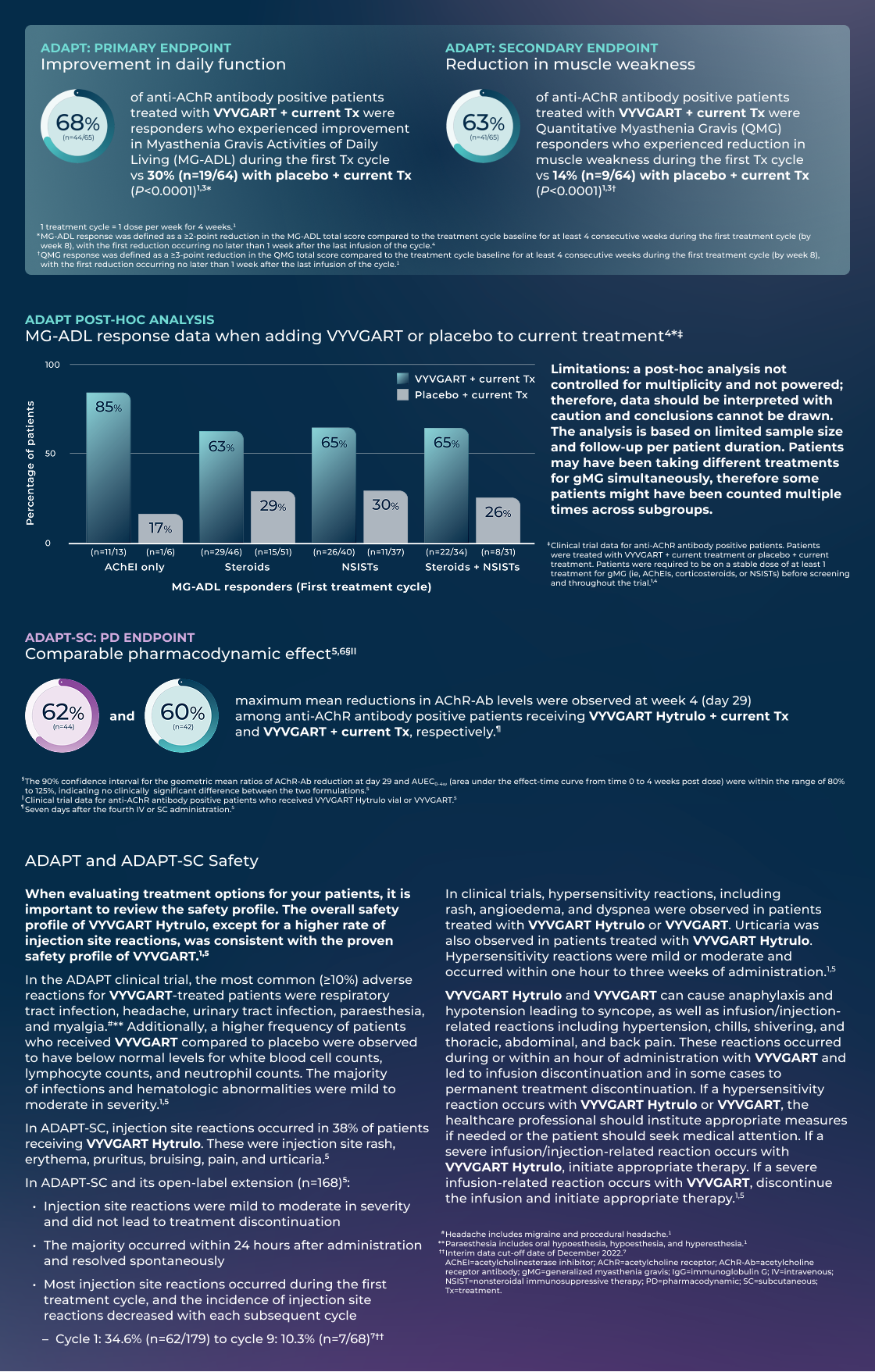
See pivotal data from the ADAPT and ADAPT-SC clinical trials below. The ADAPT phase 3 clinical trial was a 26-week, multicenter, randomized, double-blind, placebo-controlled trial in 167 adult patients with gMG. The ADAPT-SC phase 3 clinical trial was a 10-week, multicenter, randomized, open-label, parallel-group trial in 110 adult patients with gMG.1,2
Could VYVGART Hytrulo or VYVGART be an appropriate addition to your patients’ current treatment?
Discover additional data for VYVGART Hytrulo and VYVGART at VYVGARTHCP.com/gmg/clinical-data
IMPORTANT SAFETY INFORMATION AND INDICATION
CONTRAINDICATIONS
VYVGART and VYVGART HYTRULO are contraindicated in patients with serious hypersensitivity to efgartigimod alfa products or to any of the excipients of VYVGART or VYVGART HYTRULO, respectively. VYVGART HYTRULO is also contraindicated in patients with serious hypersensitivity to hyaluronidase. Reactions have included anaphylaxis and hypotension leading to syncope.
WARNINGS AND PRECAUTIONS
Infections
VYVGART and VYVGART HYTRULO may increase the risk of infection. The most common infections observed in Study 1 were urinary tract infection (10% of efgartigimod alfa-fcab-treated patients vs 5% of placebo-treated patients) and respiratory tract infection (33% of efgartigimod alfa-fcab-treated patients vs 29% of placebo-treated patients). Patients on efgartigimod alfa-fcab vs placebo had below normal levels for white blood cell counts (12% vs 5%, respectively), lymphocyte counts (28% vs 19%, respectively), and neutrophil counts (13% vs 6%, respectively). The majority of infections and hematologic abnormalities were mild to moderate in severity. Delay the administration of VYVGART or VYVGART HYTRULO in patients with an active infection until the infection has resolved; monitor for clinical signs and symptoms of infections. If serious infection occurs, administer appropriate treatment and consider withholding treatment with VYVGART or VYVGART HYTRULO until the infection has resolved.
Immunization
Evaluate the need to administer age-appropriate vaccines according to immunization guidelines before initiation of a new treatment cycle with VYVGART or VYVGART HYTRULO. The safety of immunization with live vaccines and the immune response to vaccination during treatment with VYVGART or VYVGART HYTRULO are unknown. Because VYVGART and VYVGART HYTRULO cause a reduction in immunoglobulin G (IgG) levels, vaccination with live vaccines is not recommended during treatment with VYVGART or VYVGART HYTRULO.
Hypersensitivity Reactions
In clinical trials, hypersensitivity reactions, including rash, angioedema, and dyspnea were observed in patients treated with VYVGART or VYVGART HYTRULO. Urticaria was also observed in patients treated with VYVGART HYTRULO. Hypersensitivity reactions were mild or moderate, occurred within 1 hour to 3 weeks of administration. Anaphylaxis and hypotension leading to syncope have been reported in postmarketing experience with intravenous efgartigimod alfa-fcab. Anaphylaxis and hypotension occurred during or within an hour of administration and led to infusion discontinuation and in some cases to permanent treatment discontinuation. Monitor for clinical signs and symptoms of hypersensitivity reactions during and for 1 hour after VYVGART administration, or for at least 30 minutes after VYVGART HYTRULO administration. If a hypersensitivity reaction occurs, the healthcare professional should institute appropriate measures if needed or the patient should seek medical attention.
Infusion-Related Reactions
Infusion-related reactions have been reported with VYVGART in postmarketing experience. The most frequent symptoms and signs were hypertension, chills, shivering, and thoracic, abdominal, and back pain. Infusion-related reactions occurred during or within an hour of administration and led to infusion discontinuation. If a severe infusion-related reaction occurs during administration, discontinue VYVGART infusion and initiate appropriate therapy. Consider the risks and benefits of readministering VYVGART following a severe infusion-related reaction. If a mild to moderate infusion-related reaction occurs, patients may be rechallenged with close clinical observation, slower infusion rates, and pre-medications.
Infusion/Injection-Related Reactions
Infusion-related reactions have been reported with intravenous efgartigimod alfa-fcab in postmarketing experience. The most frequent symptoms and signs were hypertension, chills, shivering, and thoracic, abdominal, and back pain. Infusion-related reactions occurred during or within an hour of administration and led to infusion discontinuation. If a severe infusion/injection-related reaction occurs, initiate appropriate therapy. Consider the risks and benefits of readministering VYVGART HYTRULO following a severe infusion/injection-related reaction. If a mild to moderate infusion/injection-related reaction occurs, patients may be rechallenged with close clinical observation, slower infusion/injection rates, and pre-medications.
ADVERSE REACTIONS
In Study 1, the most common (≥10%) adverse reactions in efgartigimod alfa-fcab-treated patients were respiratory tract infection, headache, and urinary tract infection. In Study 2, the most common (≥10%) adverse reactions in VYVGART HYTRULO-treated patients were injection site reactions and headache. Injection site reactions occurred in 38% of VYVGART HYTRULO-treated patients, including injection site rash, erythema, pruritus, bruising, pain, and urticaria. In Study 2 and its open-label extension, all injection site reactions were mild to moderate in severity and did not lead to treatment discontinuation. The majority occurred within 24 hours after administration and resolved spontaneously. Most injection site reactions occurred during the first treatment cycle, and the incidence decreased with each subsequent cycle.
USE IN SPECIFIC POPULATIONS
Pregnancy
As VYVGART and VYVGART HYTRULO are expected to reduce maternal IgG antibody levels, reduction in passive protection to the newborn is anticipated. Risk and benefits should be considered prior to administering live vaccines to infants exposed to VYVGART or VYVGART HYTRULO in utero.
Lactation
There is no information regarding the presence of efgartigimod alfa-fcab from administration of VYVGART, or efgartigimod alfa or hyaluronidase from administration of VYVGART HYTRULO, in human milk, the effects on the breastfed infant, or the effects on milk production. Maternal IgG is known to be present in human milk. The developmental and health benefits of breastfeeding should be considered along with the mother’s clinical need for VYVGART or VYVGART HYTRULO, and any potential adverse effects on the breastfed infant from VYVGART or VYVGART HYTRULO or from the underlying maternal condition.
INDICATION
VYVGART® (efgartigimod alfa-fcab) for intravenous infusion and VYVGART HYTRULO® (efgartigimod alfa and hyaluronidase-qvfc) for subcutaneous injection are each indicated for the treatment of generalized myasthenia gravis in adult patients who are anti-acetylcholine receptor (AChR) antibody positive.
Please see the full Prescribing Information for VYVGART and the full Prescribing Information for VYVGART HYTRULO.
You may report side effects to the US Food and Drug Administration by visiting http://www.fda.gov/medwatch or calling 1-800-FDA-1088. You may also report side effects to argenx US, Inc, at 1-833-argx411 (1-833-274-9411).
Dosage Forms and Strengths: VYVGART Hytrulo is available as a single-dose subcutaneous injection containing: 200 mg/mL of efgartigimod alfa and 2,000 U/mL of hyaluronidase per prefilled syringe, or 180 mg/mL of efgartigimod alfa and 2,000 U/mL of hyaluronidase per vial.
VYVGART is available as a single-dose injection for intravenous use containing 400 mg/20 mL of efgartigimod alfa-fcab per vial.
References: 1. VYVGART. Prescribing information. argenx US Inc; 2025. 2. Howard JF Jr et al. Neurotherapeutics. 2024;21(5):e00378. doi:10.1016/j.neurot.2024.e00378 3. Howard JF Jr et al. Lancet Neurol. 2021;20(7):526-536. doi:10.1016/S1474-4422(21)00159-9 4. Karam C et al. Presented at: Myasthenia Gravis Foundation of America (MGFA) National Conference; April 11-13, 2021. Canada. Virtual. 5. VYVGART Hytrulo. Prescribing information. argenx US Inc; 2025. 6. Data on file. REF-01900. argenx US Inc. June 2023. 7. Howard JF Jr et al. Poster presented at: American Academy of Neurology (AAN) Annual Meeting; April 13-18, 2024. Denver, CO.

For US audiences only.
VYVGART and VYVGART Hytrulo are registered trademarks of argenx.
© 2025 argenx US-VYV-25-00243 V1 10/2025. All Rights Reserved.
-
Ronald Davis4wRecently saw expansion of indication makes it a bit more interesting to use!
-
Meyer Halberstam4wAm considering using Vyvgart. The data is very impressive