



What are the treatment options for myasthenia gravis if first-line agents fail?
Source : https://www.ccjm.org/content/90/2/81
If the patient with myasthenia gravis (MG) has been taking adequate doses of a first-line medication, typically pyridostigmine, for a sufficient duration but without significant efficacy, or has experienced substantial...
Conclusions: If the patient with myasthenia gravis (MG) has been taking adequate doses of a first-line medication, typically pyridostigmine, for a sufficient duration but without significant efficacy, or has experienced substantial adverse effects, it may be time to consider immunosuppressive therapy. In 5% to 20% of patients, there may be...

Treatment patterns in myasthenia gravis: a United States health claims analysis - PubMed
Source : https://pubmed.ncbi.nlm.nih.gov/36721910/
The .gov means it's official. Federal government websites often end in .gov or .mil. Before sharing sensitive information, make sure you're on a federal government site. The site is secure....
Conclusions: Many patients experienced exacerbations and received rescue therapy despite treatment, suggesting current treatments may not provide adequate disease control for some patients, and additional treatment options should be explored.
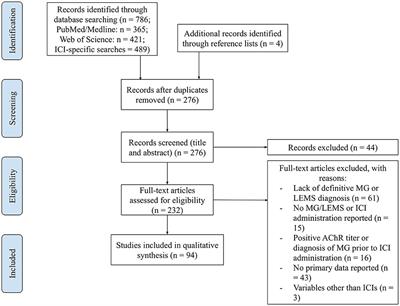
Exploring the role of immune checkpoint inhibitors in the etiology of myasthenia gravis and Lambert-Eaton myasthenic syndrome: A systematic review
Source : https://www.frontiersin.org/articles/10.3389/fneur.2022.1004810/full
BackgroundWhile immune checkpoint inhibitors (ICIs) have been revolutionary in the treatment of cancer, their administration has been associated with a variety of immune-related adverse events (irAEs), including myasthenia gravis (MG),...
Conclusions: We argue that there is a need for future mechanistic, high quality, large-scale studies specifically investigating the possible etiological role of ICIs in MG/LEMS.

Effectiveness of early cycles of fast-acting treatment in generalised myasthenia gravis
Source : https://jnnp.bmj.com/content/early/2023/01/23/jnnp-2022-330519
Background Early fast-acting treatment (EFT) is the aggressive use of fast-acting therapies such as plasmapheresis, intravenous immunoglobulin and/or intravenous high-dose methylprednisolone (IVMP) from the early phases of treatment. EFT is...
Conclusions: Early cycles of intervention with EFT and early use of calcineurin inhibitors provides long-term benefits in terms of achieving therapeutic targets for generalised MG, regardless of clinical subtype.

Reduced Number of Thymoma CTLA4-Positive Cells Is Associated With a Higher Probability of Developing Myasthenia Gravis
Source : https://nn.neurology.org/content/10/2/e200085
Background and Objectives Myasthenia gravis (MG) is an autoimmune disease associated with comorbid thymoma in 10%-15% of cases. Cytotoxic T lymphocyte-associated antigen 4 (CTLA4) expressed by T cells downregulates T-cell-mediated...
Conclusions: Reduced CTLA4 expression in thymoma may predispose to a higher risk of developing MG.