



CGRP-mediated trigeminovascular reactivity in migraine patients treated with erenumab
Source : https://jnnp.bmj.com/content/early/2022/01/26/jnnp-2021-327992
Migraine is a highly disabling disorder characterised by recurrent attacks of severe headache (https://ichd-3.org/). The trigeminovascular system and release of calcitonin gene-related peptide (CGRP), a neuromodulator and potent vasodilator, have...
Relevance: We evaluated whether erenumab inhibits the forehead capsaicin-induced DBF response and whether the degree of capsaicin-induced DBF response before treatment is different in patients with an adequate versus suboptimal clinical response to erenumab.
-
Dr Hamid4yrMigraine is a highly disabling disorder characterised by recurrent attacks
-
Huma Sheikh, CEO, NY Neurology Medicine, PC4yrThis is interesting to see the reactions.

Predictors of Sustained Response and Effects of Anti-CGRP Antibodies Discontinuation and Reinitiation in Resistant Chronic Migraine - PubMed
Source : https://pubmed.ncbi.nlm.nih.gov/35098620/
In most patients, the 3-month discontinuation of anti-CGRP mAbs resulted in progressive migraine deterioration that was rapidly reverted by retreatment. However, one-fourth of patients, who reported better quality of life...
Conclusions: In most patients, the 3-month discontinuation of anti-CGRP mAbs resulted in progressive migraine deterioration that was rapidly reverted by retreatment. However, one-fourth of patients, who reported better quality of life indices before treatment, showed a sustained benefit during discontinuation and did not need retreatment.
-
Dr Hamid4yrImportant to fully evaluate migraine patients
-
Huma Sheikh, CEO, NY Neurology Medicine, PC4yrThese are a good way to know who may respond.

Detoxification vs non-detoxification before starting an anti-CGRP monoclonal antibody in medication overuse headache - PubMed
Source : https://pubmed.ncbi.nlm.nih.gov/35135357/
1 Department of Biomedical and NeuroMotor Sciences of Bologna, University of Bologna, Bologna, Italy. 2 Medical Toxicology-Headache and Drug Abuse Research Centre, Department of Biomedical, Metabolic and Neural Sciences, University...
Conclusion: Our results support the emerging evidence that anti-CGRP monoclonal antibodies may be effective in medication overuse headache patients irrespective of detoxification, yet further studies are needed to draw definitive conclusions.
-
Dr Hamid4yrMedication overuse headache significantly contributes to the chronification process and treatment refractoriness of migraine
-
Huma Sheikh, CEO, NY Neurology Medicine, PC4yrThis is important because taking patients off of abortives can be difficult.
Long-Term Effectiveness of Three Anti-CGRP Monoclonal Antibodies in Resistant Chronic Migraine Patients Based on the MIDAS score - CNS Drugs
Source : https://link.springer.com/article/10.1007/s40263-021-00893-y
Background Criteria, including clinical features and effective outcomes, for access and persistence of novel but costly treatments may vary between countries, thus affecting the health of patients. Monoclonal antibodies against...
Conclusion: In resistant chronic migraine patients, anti-CGRP mAbs are effective and safe. A ≥ 50% reduction in MIDAS score seems to be the most advantageous outcome measure in this setting, which allows most severe migraine patients to persist with treatment.
-
Dr Hamid4yrIn resistant chronic migraine patients, anti-CGRP mAbs are effective
-
Huma Sheikh, CEO, NY Neurology Medicine, PC4yrThe MIDAS is a helpful score.
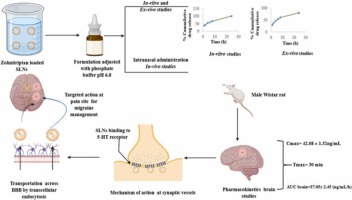
Nose-to-brain lipid nanocarriers: An active transportation across BBB in migraine management
Source : https://www.sciencedirect.com/science/article/abs/pii/S0009308422000056?via=ihub
Glyceryl monostearate-based nanoparticles helped in the entrapment of drug in the lipophilic matrix system. * High-pressure homogenization used for preparation of Solid Lipid Nanoparticles (SLNs). * These SLNs via intranasal...
Conclusion/Relevance: Zolmitriptan-loaded SLNs via intranasal administration offers a novel approach to effectively circumvent first-pass hepatic metabolism than conventional oral route with 4-fold alleviation in permeation and 2-fold improvement in bioavailability.